
SPY Weekly Trading Playbook: Navigating the February 2026 Volatility Gap
Strategic Outlook for the Week of February 2-6, 2026
I. Market Context: The State of the Benchmark
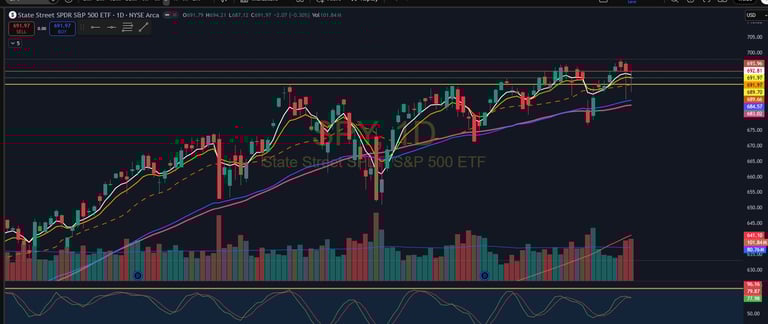
As of the market close on January 30, 2026, the SPY ETF stands at a critical psychological and structural juncture. Closing at $691.97, the index has spent the last fourteen trading sessions consolidating just below the $700 "Century Mark." This consolidation comes on the heels of a massive Q4 2025 rally, leaving the current RSI (Relative Strength Index) at a heated 70.14 on the daily chart.
While the long-term trend remains firmly bullish, the immediate-term technicals suggest we are entering a "Mean Reversion" window. The 20-day Simple Moving Average (SMA) currently sits at $686.50, representing a 0.8% downside risk if momentum stalls. However, the bull case remains supported by strong institutional call-buying in the $710-$720 strikes for March expiration, suggesting that professional "smart money" is viewing any February pullback as a buying opportunity rather than a trend reversal.
II. Critical Levels to Watch (The 2026 Pivot Map)
Key Support Zones:
$690.00 - $691.00: This is the primary high-volume node from the previous week. If the bulls cannot hold $691 on a Monday gap-down, the door opens for a rapid flush toward the secondary trendline.
$686.50: The "Alpha Support." This level aligns with the 20-day SMA. Historically, SPY tends to bounce within 0.5% of this moving average during an uptrend. A daily close below this level would be the first sell signal of 2026.
$680.00 - $682.00: The Gap-Fill Zone. There is a price imbalance from the mid-January rally that has yet to be tested. If volatility spikes due to Friday's NFP data, this is the logical destination for a liquidity sweep.
$671.00: The Bearish Engulfing Level. This represents the low of the January 5th pivot. A breach of this level would invalidate the current bull structure and shift our weekly bias to "Aggressive Short."
Key Resistance Zones:
$694.50 - $695.50: Recent swing highs. This zone has acted as a "supply wall" where sellers have stepped in three times in the last week.
$697.84: The All-Time High (ATH). This is the final boss for the bulls.
$700.00: The Psychological Barrier. Above $700, there is no historical price data (Blue Sky Breakout). Expect massive volatility and "Gamma Squeezes" as market makers are forced to hedge their positions.
III. Actionable Trade Setups: The Smart Trades Protocol
Bullish Scenario (55% Probability): The "Buy the Dip" Continuation
If SPY successfully defends the $690 level during the Monday morning "Discovery Phase" (9:30 AM - 10:30 AM ET), the bias remains bullish.
Entry: Look for a 5-minute candle reversal pattern (Hammer or Engulfing) at $691.25.
Targets: Target 1 at $694.50 (Scalp exit); Target 2 at $697.50 (ATH test).
Stop Loss: A hard stop at $688.75 to protect against a liquidity flush.
Technical Confirmation: We look for the MACD to cross bullishly on the 15-minute timeframe. For a deeper understanding of these entry patterns, refer to our Technical Analysis Playbooks.
Bearish Scenario (45% Probability): The "Earnings Fade"
If Palantir (PLTR) or Alphabet (GOOGL) report earnings that the market deems "priced in," we could see a sector-wide tech sell-off that drags SPY through its support floors.
Entry: Short on a definitive break and 15-minute close below $689.50.
Targets: Target 1 at $686.50 (20-day SMA); Target 2 at $682.00 (Gap fill).
Stop Loss: Above $692.50 (Invalidation point).
Risk Alert: Avoid shorting into high-volume "exhaustion" candles. We detail the dangers of "catching falling knives" in our ==Day Trading Playbook==.
IV. The "Theta Burn" Warning: Managing Mid-Week Chop
The biggest danger this week isn't a market crash—it’s a sideways grind. With the Non-Farm Payrolls (NFP) report scheduled for Friday, February 6, institutional players often "flat" their books between Tuesday afternoon and Thursday morning.
This creates a "Theta Burn" environment where premiums for both calls and puts are destroyed as implied volatility (IV) crushes. If you see SPY oscillating in a tight $2 range ($691-$693) on low volume, stay on the sidelines. Over-trading in a chop zone is the fastest way to blow a small account.
V. High-Impact Economic Calendar (February 2-6, 2026)
Monday, Feb 2: Construction Spending (10:00 AM) and Palantir (PLTR) Earnings (Post-Market). PLTR is a high-beta retail favorite; its reaction will dictate tech sentiment for Tuesday's open.
Tuesday, Feb 3: JOLTS Job Openings (10:00 AM). The Fed is watching labor demand closely. A "Hot" number (higher than expected) will push yields up and SPY down.
Wednesday, Feb 4: ISM Services PMI and 3-Year Note Auction. Bond market volatility often spills into the SPY $700 breakout attempt.
Friday, Feb 6: The "Main Event." Non-Farm Payrolls (8:30 AM). Expect 2-3% of intraday volatility. This is the ultimate decider for the February trend.
VI. Trading Strategy for Maximum Profit
Day 1-2 (Mon-Tue): Trade the "Earnings Sympathy." Focus on tech-heavy components of SPY. If PLTR gaps up and holds, look for SPY to test $695.
Day 3-4 (Wed-Thu): The "Anticipation Phase." Reduce position size by 50%. This is the highest risk of "fake-outs."
Day 5 (Friday): The "NFP Explosion." Be flat before 8:30 AM. Enter only after the 10:00 AM "Trend Confirmation." Use the "Second Leg" strategy found in our ==Risk Management Playbook== to ensure you aren't chasing the initial news spike.
VII. Risk Management Rules for February 2026
Position Sizing: In 2026's high-volatility regime, no single trade should represent more than 2% of your total liquid capital.
The 3% Rule: SPY is currently extended from its mean. If SPY reaches $712 (3% above the 20-day SMA), profit-taking is mandatory. Do not get greedy at all-time highs.
Hard Stops Only: In a "Flash Crash" or "News Gap" environment, mental stops do not exist. Use GTC (Good Til Canceled) stop-market orders to preserve your capital.
VIII. Bottom Line: The Decision Point
SPY is at a crossroads. While the "Mag 7" and AI demand suggest the $700 breakout is inevitable, the overbought technicals and the looming NFP data demand caution. The successful trader this week will be the one who waits for the market to reveal its hand at the $690 support or $697 resistance. Patience is the ultimate competitive advantage.
Pro Tip: Watch the VIX (Volatility Index). If the VIX stays below 14.50, the "Buy the Dip" regime is still in play. If VIX crosses 16.00, the $680 gap-fill becomes the primary target.

© 2026 Smart Trades Zone. All rights reserved.
DISCLAIMER: Trading stocks, options, and other financial instruments involves substantial risk and is not suitable for every investor. The intelligence and trade setups provided by Tom Smart and Smart Trades Zone are for educational and informational purposes only and do not constitute professional financial advice. Past performance is not indicative of future results. All trading involves the risk of total capital loss. Always consult with a licensed financial professional before making any investment decisions.