
Sentiment: High Volatility / Tactical Neutral:
At Smart Trades Zone, we don't trade headlines; we trade the market's reaction to the headlines. Our approach to Market Intelligence is built on the "Smart Trades News Protocol"—a systematic three-step process that filters the noise and focuses on high-probability setups.
1. ANTICIPATION: We begin with the economic calendar, identifying the high-impact catalysts like NFP, FOMC, and Big Tech earnings. We don't guess the outcome; we define the "consensus" to understand where the market’s expectations are anchored.
2. ALIGNMENT: Once the news breaks, we cross-reference the data with our Technical Analysis Playbook. We look for alignment between the macro narrative and key liquidity zones on the $SPY, $QQQ, and $IWM charts. If the data is "Bullish" but price fails to break resistance, the trade is off.
3. EXECUTION: We utilize specific "News Momentum" and "Opening Range" strategies from our Day Trading Playbook to enter with precision. By pre-defining our risk and pivot points, we capitalize on the volatility spike while protecting our capital from the initial "whipsaw." At Smart Trades Zone, our news intelligence is the spark, but our structural playbooks are the engine.
The first full week of February 2026 has arrived, and it brings with it a "perfect storm" of technical and fundamental catalysts. While the S&P 500 ($SPY) enters the month at a crossroads, trading near historical valuation extremes, the real narrative is being written in the high-stakes world of AI earnings and a massive liquidity shakeout in precious metals.
As a professional trader, your job isn't to predict the future—it's to have a plan for every probable scenario. In this briefing, we break down the three primary drivers that will define the market's trajectory for the rest of Q1 2026.
1. The Silver Liquidity Crisis: A Systemic Warning?
In a move that has stunned veteran commodity traders, Silver ($SLV) has transitioned from a parabolic 50% rally in January to a historic "flash crash." After touching record highs of $120.45 per ounce earlier in the week, we saw an eye-watering drop back toward the $78.50 level on Friday as speculative positioning from retail and crypto-linked funds unwound in a massive "long squeeze."
The Macro Implications
This isn't just about a metal; it’s about liquidity. When a major commodity experiences a 30% drawdown in 48 hours, it often triggers margin calls across the broader financial system. We are watching the Gold-to-Silver ratio closely for a "safety trade" signal. If Silver fails to find support at the $75 zone, we expect the "Risk-Off" contagion to bleed into high-beta tech names.
The Strategy: Successful traders don't buy the "falling knife." Instead, we wait for a base to form. As we discuss in our Technical Analysis Playbook, waiting for a "higher low" confirmation on the 1-hour chart is the only way to play these high-volatility environments safely. Do not let FOMO override your charting discipline.
2. The Palantir ($PLTR) Litmus Test: AI Revenue vs. Valuation
On Monday, February 2, Palantir Technologies reports its Q4 2025 earnings after the market close. This is arguably the most important earnings report of the quarter for the retail trading community. Wall Street is expecting record revenue near $1.34 billion—a staggering 60% year-over-year increase.
The Valuation Trap
Despite the growth, $PLTR is facing a significant "valuation wall." The stock saw a 12% pullback in early January as investors questioned if the current multiples are sustainable.
* The Bull Scenario: A massive beat on AIP (AI Platform) commercial revenue with guidance raised for 2026. A breakout above $160 would signal a new leg of the "AI Supercycle."
* The Bear Scenario: A "Beat and Fade." If Palantir hits the numbers but guidance is only "inline," expect a "sell the news" event. A break below the $147 support level could trigger a flush toward $120.
The Strategy: This is a pure volatility play. The options market is pricing in a +/- 11% move. If you are day-trading the reaction, ensure you are utilizing the "Opening Range Breakout" strategies outlined in our Day Trading Playbook to capture the move without getting trapped in the initial "whipsaw" of the 9:30 AM open.
3. The Friday "NFP" Macro Hammer: The Fed’s Final Boss
The ultimate decider for the week's closing price will be Friday’s Non-Farm Payroll (NFP) report on February 6th. The consensus forecast is calling for approximately 89k job additions—a rise from December’s 50k print.
Why the Jobs Report is the "Magic Number"
* The "Goldilocks" Scenario (80k - 110k): This would confirm that the labor market is cooling slowly but not collapsing. This is the "Soft Landing" narrative that the Fed wants, and it would likely fuel a rally in the Russell 2000 ($IWM).
* The "Hot" Scenario (>175k): High job growth means sticky inflation. This would send bond yields soaring and crush $QQQ, as tech valuations are highly sensitive to rising rates.
* The "Hard Landing" Scenario (<50k): This triggers recession fears. Stocks would likely gap down regardless of the Fed's potential for rate cuts.
The Strategy: NFP Friday is a "trap" for most retail traders. High-impact news events require a shift in psychology. You must prioritize capital preservation over profit-seeking. Before the data drops at 8:30 AM ET, review our Trading Psychology Playbooks to ensure you aren't trading out of "desperation" or "revenge" if the initial move goes against you.
Technical Levels to Watch: The "Line in the Sand"
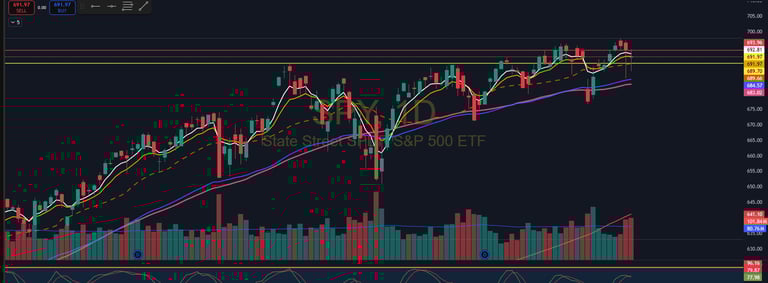
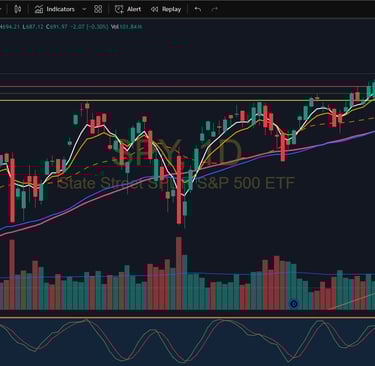
S&P 500 ETF ($SPY)
* Key Pivot: $618.50.
* The Bull Case: We need to see a daily close above $622.50 to invalidate the "head and shoulders" pattern forming on the daily chart.
* The Bear Case: A sustained break below $618.00 opens a high-probability "air pocket" down to $614.00, where the 50-day moving average currently sits.
Nasdaq 100 ETF ($QQQ)
* Key Pivot: $530.00.
* The Bull Case: Reclaiming $535.00 is essential to prove that the AI-led momentum has one more leg.
* The Bear Case: The $528.50 level is the last line of defense. Below this, we expect a rapid rotation into defensive sectors like Health Care and Utilities.
The Empire Mindset: Professionalism Over Gambling
The difference between a $10/month hobbyist and a $10,000/month professional is Discipline.
During "Catalyst Weeks," the temptation to "bet it all" on an earnings gap or an NFP print is high. But wealth is built on the compound interest of correct decisions, not the lucky outcome of a single gamble.
Your 5-Point Execution Plan:
1. Monday Morning: Watch the $SLV support levels at $75. Do not initiate long positions in equities if the metals market is still in "freefall."
2. Monday After-Hours: Observe the $PLTR reaction. Do not trade the "thin" after-hours market; wait for Tuesday’s regular session volume.
3. Mid-Week: Focus on "Sector Rotation." If tech is weak, watch $IWM for a catch-up trade.
4. Thursday: Scale down positions. Reduce leverage by at least 50% ahead of NFP.
5. Friday: Be a spectator at 8:30 AM. Let the algorithms fight for the first 30 minutes. Enter only when the trend is established.
This week will be volatile, but for the prepared trader, volatility is simply "opportunity in motion." Respect your stops, trust your charts, and trade the plan.
*Disclaimer: Smart Trades Zone provides high-level market analysis for educational and informational purposes only. Trading stocks, options, and commodities involves a high risk of loss. Always consult with a licensed financial advisor before making investment decisions.
Market Intelligence Masterclass: Navigating the February 2026 Catalyst Storm
February 1, 2026 | Market Analysis

© 2026 Smart Trades Zone. All rights reserved.
DISCLAIMER: Trading stocks, options, and other financial instruments involves substantial risk and is not suitable for every investor. The intelligence and trade setups provided by Tom Smart and Smart Trades Zone are for educational and informational purposes only and do not constitute professional financial advice. Past performance is not indicative of future results. All trading involves the risk of total capital loss. Always consult with a licensed financial professional before making any investment decisions.